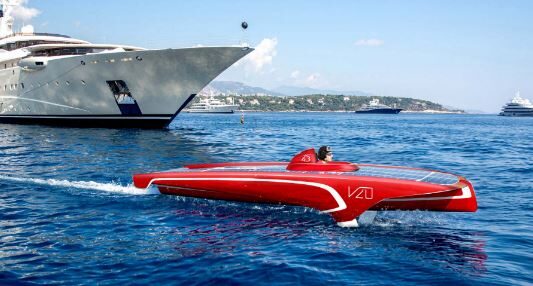
The TU Delft Solar Boat team marks a significant milestone not only as the inaugural Dutch contender but also as the first student group daring to construct a solar-powered vessel designed to conquer the tumultuous open sea. To withstand the formidable high waves and powerful wind gusts offshore, this year’s innovative design features a trimaran hull. This distinctive three-hulled configuration provides exceptional width, ensuring critical stability. Measuring an impressive eight by six meters, the boat boasts a substantially expanded solar deck, spanning a remarkable 28 square meters – an area equivalent to nine combined double beds.
This vast «Solardeck» generates ample energy, capable of powering, for instance, three electric kettles simultaneously. A pivotal innovation lies in its hydrofoil “support wings.” These load-bearing foils enable the trimaran to not merely sail but to ascend above the water’s surface at high speeds. By lifting the three hulls clear of the water, these foils dramatically diminish hydrodynamic resistance, allowing the solar boat to attain impressive speeds purely on energy harnessed from sunlight.
Notably, this year’s design accommodates not one, but three passengers, representing a crucial stride towards sustainable maritime passenger transport. This demonstrates the team’s commitment to proving that solar energy offers a practical and viable solution for nautical travel.
This ambitious undertaking by the Solar Boat Team Delft undeniably pushes the frontiers of solar-powered marine technology, directly addressing the formidable challenges of offshore navigation.
The following outlines the critical significance behind their innovative design choices:
TU Delft’s Solar Boat: Engineered for Open Sea Conquest
Beyond its distinction as the first Dutch entry, the Solar Boat Team Delft holds the unique position of being the pioneering student collective to embrace the monumental task of constructing a solar vessel capable of navigating the tempestuous and unpredictable conditions of the open ocean. This pivotal transition from tranquil inland waterways to the expansive sea necessitates groundbreaking innovation in both design and inherent stability.
The Strategic Trimaran Design
To effectively contend with the high waves and potent wind gusts characteristic of offshore environments, this year’s vessel incorporates a trimaran configuration. This three-hulled architecture is deliberately chosen for its inherent width, which is paramount for ensuring unwavering stability.
-
Enhanced Stability: The trimaran configuration offers exceptional lateral stability and buoyancy, far surpassing that of conventional monohull vessels. This robust stability is vital for occupant safety in turbulent waters and enables the boat to maintain a precise heading.
-
Minimized Drag: Despite its broad stance, the streamlined profile of each individual hull contributes significantly to minimizing hydrodynamic drag. This is crucial for optimizing speed and efficiently utilizing the finite power supplied by the solar panels.
-
Optimized Solar Platform: The expansive deck created by the tri-hull structure is indispensable for securely mounting and supporting the substantial solar array.
 Laura Dekker Christens the Pioneer Dutch Solar Boat
Laura Dekker, renowned as the youngest sailor to circumnavigate the globe solo, embarked on her epic voyage from Gibraltar at just 14 years old. After covering approximately 50,000 kilometers, she triumphantly concluded her world tour in Saint-Martin in 2012. Kristian Ruiter, director of the TU Delft Solar Boat team, found it fitting for Dekker to christen the vessel. He remarked, «Her audacious solo circumnavigation was not universally embraced. Yet, her unwavering determination to pursue her dreams, despite her youth, exemplifies what can be achieved through immense perseverance and resolute will.»
Dekker herself drew parallels: «Similar to my own journey, the TU Delft Solar Boat team initially encountered skepticism upon announcing their ambitious project. Many deemed it impossible and outlandish, particularly for such a young team. At the time, it indeed seemed unfeasible, much like the idea of a young girl sailing solo around the world once did.»
This summer, the team is set to compete in the premier international event for sustainable maritime craft, the Solar & Energy Boat Challenge. The rigorous competition features two demanding phases, each spanning over 90 kilometers, navigating waters between France and Italy. Victory hinges on achieving the fastest combined time across both legs. While the team is fully committed to securing a win, it acknowledges the formidable challenge of competing against well-resourced businesses and experienced private entries.
Beyond their competitive aspirations, a significant objective for the coming year is to claim a new world record: crossing the English Channel as the fastest solar boat ever constructed. Slated for late July, the team will attempt to traverse the iconic stretch of sea between Calais and Dover. Through both their participation in the Monaco race (Solar & Energy Boat Challenge) and this audacious world record attempt, the team aims to unequivocally demonstrate the immense potential of sustainable technologies, even in demanding offshore environments, thereby inspiring innovation across the broader maritime sector.
The dedicated TU Delft Solar Boat Team comprises 28 ambitious students from ten distinct faculties within the university. Within a single year, these students meticulously manage every phase: from initial design and production to rigorous testing and ultimately racing their solar-powered vessel. Since its inception in 2005, the TU Delft Solar Boat initiative has consistently championed the adoption of more sustainable practices within the maritime industry. Until last year, the students focused on developing solar boats for inland navigation, consistently showcasing the remarkable achievements possible through student innovation and solar energy. This current year marks their pioneering venture into the challenging realm of offshore navigation.
HomeCamper proudly extends its support to this groundbreaking endeavor and eagerly anticipates further innovations from the TU Delft Solar Boat team.