Yearning for an outdoor pursuit that offers a genuine escape from the daily grind? Are you drawn to challenging experiences and eager to master new competencies? This article will unravel the meaning of survival, its fundamental principles, and the critical equipment you’ll need as you prepare for your inaugural wilderness journey.
Survival refers to activities focused on enduring and thriving in challenging environments. A concise definition, coined by Polish writer and advocate Krzysztof J. Kwiatkowski, describes survival as ‘self-preservation’.
At its core, survival hinges on acquiring and applying knowledge and practical skills to meet essential needs in demanding terrain. It’s about navigating unfamiliar surroundings, often under adverse weather conditions, when external assistance is distant and the conveniences of modern civilization are unavailable.
Survival is widely regarded as an interdisciplinary field, drawing insights from diverse sciences such as medicine, psychology, physiology, physics, chemistry, geography, botany, and meteorology. The psychological and personality traits of individuals involved in survival scenarios are paramount. It’s an endeavor for those who can tolerate discomfort, exhibit patience and perseverance, and possess the ability to manage emotions and make swift, rational decisions amidst stressful circumstances.
From a historical perspective, the origins of survival can be traced back to our ancient ancestors. For prehistoric humans, developing such abilities was a matter of life and death. Today, however, it predominantly serves as a compelling form of recreational activity.
The concept of survival is broader than many realize. According to commonly accepted classifications, it encompasses three distinct domains.
This area involves acquiring and maintaining the knowledge and abilities required for military duties. While often associated with wartime preparedness, recreational forms also exist, attracting enthusiasts not directly affiliated with the armed forces. Military survival scenarios might include operating in extreme conditions like bombing raids or artillery fire, typically involving severely limited access to vital resources such as water, food, and medical supplies.
This type of survival addresses extreme events like natural disasters (e.g., earthquakes, floods), power outages, terrorist attacks, or civil unrest in urban settings. Urban survival activities frequently involve restricted access to potable water and food, communication breakdowns, heightened epidemiological risks, or managing crowd aggression. Given the involvement of larger populations, an understanding of psychology, social phenomena, and group behaviors becomes crucial. Resilience to stress and the capacity for rapid decision-making are indispensable.
This discipline most closely aligns with the common understanding of the term ‘survival’, which will be our primary focus in this article. Green or wilderness survival is centered on practical knowledge and skills that enable sustained existence in natural settings, far removed from modern amenities. A crucial tenet here is deep respect for nature; our actions should minimize environmental impact.
Wilderness survival can be an incredibly rewarding form of recreation, though it’s certainly not for everyone. It appeals to individuals seeking temporary refuge in nature to escape urban commotion, who desire relaxation while also craving unconventional experiences and embracing new challenges. Furthermore, they are unfazed by a lack of comfort or unpredictable weather. If you anticipate a luxurious retreat, you might find yourself disappointed.
Does it hold value? The surging popularity of various survival courses and camps emphatically suggests it does. Moreover, this form of recreation captivates both adults and children, offering a respite from digital devices. Survival instills skills that are beneficial not only during catastrophic events but also in more commonplace situations (e.g., unexpected storms on a hiking trail or a family camping trip by a lake). It fosters improvisation and cultivates character.
If you decide to embark on such an adventure, you’ll need to absorb knowledge across diverse fields and develop a core set of practical abilities. Here are some examples of skills typically taught to survival practitioners.
Are you certain that a mountain stream is free of protozoa or bacteria that could lead to illness? You can’t discern this ‘with the naked eye.’ Therefore, mastering water purification techniques is crucial to preventing gastrointestinal distress.
During a survival outing, nourishment is essential. Expect to learn plant and mushroom identification, distinguishing edible from poisonous varieties. Additionally, basic theories of simple foraging or trapping techniques are usually covered.
In an age dominated by smartphone navigation, few individuals truly know how to use a map and compass effectively. On a survival expedition, you will undoubtedly acquire this proficiency. You’ll also learn to orient yourself using natural indicators like celestial bodies or distinctive land features.
Sudden weather changes or the onset of night make finding shelter a top priority. Survival courses and camps will equip you with ‘outdoor construction’ knowledge. You’ll discover how to create an improvised shelter using minimal tools, maximizing your sense of security.
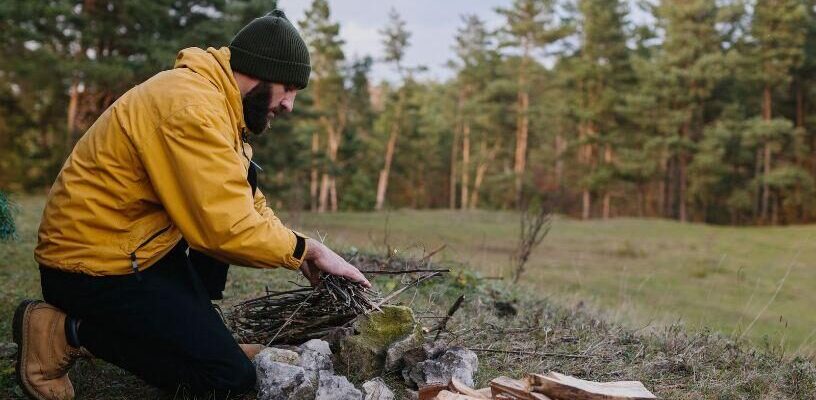
This is one of the most fundamental skills. Fire provides not only light and warmth but also enables you to cook meals. In a survival context, a bonfire can also deter wild animals. On such a journey, you’ll certainly learn about effective tinder, fuel sources, and how to ignite a flame when matches or lighters are unavailable.
Participants in these wilderness activities might occasionally ponder the precise nomenclature of their pursuit. This is because two similar terms often coexist. How can you distinguish between survival and bushcraft? A survivor must possess the necessary capabilities to endure a crisis situation. Their actions are driven by a scenario where the paramount goal is self-preservation. Survival is often impromptu, focused on overcoming immediate problems, and returning safely to civilization at the earliest opportunity.
Bushcraft, conversely, represents a lifestyle or a particular approach to engaging with nature. Enthusiasts of this activity intentionally operate close to the natural world, largely isolated from many modern conveniences, finding intrinsic value in this way of life. Consequently, they are dedicated to acquiring a broad spectrum of skills that facilitate long-term living in the wilderness.
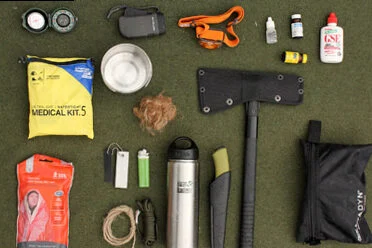
To thrive in challenging environments, you’ll need a selection of simple yet reliable tools. Wondering what your initial survival kit should contain? There’s no single definitive list. Your backpack’s contents will vary based on your skill level, the season, and the specific characteristics of your destination. Remember, for your first survival trip, it’s generally ill-advised to adopt an overly minimalist approach.
Which survival essentials will prove invaluable? Be sure to pack a robust Survival Knife. You might also consider a multifunctional tool like a Multi-tool. Always bring a physical Map and a Compass. For nighttime, you’ll require A Light Source – preferably a headlamp. Don’t forget a set of spare batteries or a Power Bank if your headlamp is rechargeable. Ensure your backpack contains a comprehensive First Aid Kit.
If you’re just starting your journey into survival, it’s unlikely you’ll be expected to be entirely self-sufficient for food. So, consider bringing lightweight and nutritious Freeze-Dried Meals. Carrying fishing Hooks and Line can significantly expand your options, allowing you to create an improvised fishing rig if needed. A travel bottle equipped with a water filter can be exceptionally useful (e.g., the LifeStraw Go 2.0). If you’re not yet proficient in building your own shelter, consider the convenience of a Hammock and a rain-resistant tarp (e.g., the Ticket to the Moon TMARP). These are merely initial suggestions; your complete list should be meticulously tailored to your individual requirements.
Looking to assemble your first survival kit? Or perhaps you’re an experienced outdoors person seeking to augment your ‘collection’? At the sports retailer They sport.ro, you’ll discover a vast selection of top-tier survival equipment from renowned brands such as Gerber, Primus, Easy Camp, Outwell, Petzl, Silva, Ledlenser, LifeStraw, Ticket to the Moon, and ENO, enabling you to pursue your passion without limitations.