
For the uninitiated, Nordic walking might appear to be simply walking with poles. However, to truly harness the benefits of this dynamic physical activity, mastering the correct technique is crucial, as is selecting the perfectly suited Nordic walking poles.
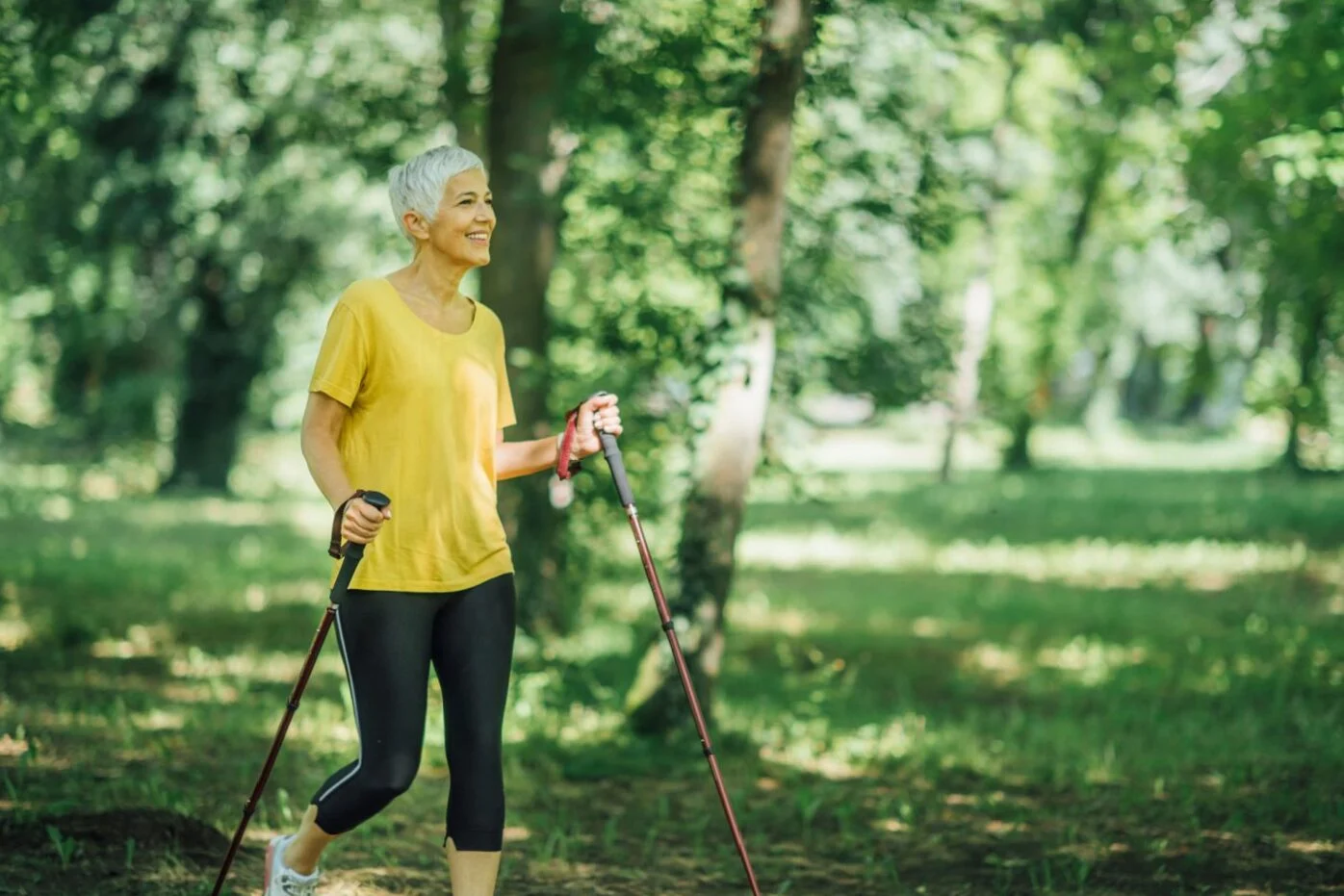
Nordic Walking, while gaining widespread popularity today, is a relatively recent addition to the recreational fitness landscape. Its origins trace back to 1920s Finland, where it was initially developed as a supplementary training method for cross-country skiers. At that time, it was known as Sauvakävely, which directly translates to “pole walking.” Today, the remarkable health-promoting properties of Nordic walking are embraced by individuals across all age groups and fitness levels, who engage in this activity throughout the year. Whether on flat terrain like urban parks, serene forest paths, or bustling city streets, it’s practiced for both leisurely recreation and dedicated fitness.
Unlike conventional walking, which primarily engages the lower body, Nordic walking actively recruits muscles from both sides of the body simultaneously. This comprehensive engagement extends to the muscles of the legs, chest, arms, shoulders, and abdomen. Significantly, the specialized Nordic walking technique is gentle on joints and the spine, fostering improved posture, enhanced balance, and superior coordination. It offers a versatile exercise option for people of all ages and body weights, suitable for seasoned athletes and complete beginners alike. Furthermore, it’s a recommended activity for individuals managing cardiovascular conditions, diabetes, cancer, as well as during pregnancy, postpartum recovery, and for professional athletes seeking to diversify their training regimens.
What other advantages does it offer? Engaging in Nordic walking with dedicated poles can boost calorie expenditure by 20-40% compared to a regular stroll, making it an excellent tool for weight management, combating obesity, or simply maintaining a lean physique. Regular practice helps alleviate stress and fatigue, releasing tension in the shoulder girdle and neck. It’s also known to positively influence resting blood pressure and cholesterol levels. Moreover, Nordic walking often encourages group participation, which can significantly enhance motivation, inspire new challenges, and facilitate the formation of new friendships.
To ensure a proper start to your Nordic walking journey, it’s highly advisable to begin under the guidance of a certified instructor. While not an overly complex sport, professional instruction can provide invaluable insights into correct technique and offer expert advice on selecting the most appropriate equipment.
Effective Nordic walking technique involves inserting the poles midway between your strides, with a fluid wrist articulation as the pole connects with the ground. For optimal performance and to achieve the desired results, choosing the right Nordic walking poles is paramount. Crucially, remember to opt for poles specifically designed for Nordic walking, not trekking poles. These terms are often mistakenly used interchangeably, leading to confusion. A true Nordic walking pole features a specialized “glove” strap system and a straight handle, whereas a trekking pole typically has simple straps and a contoured, mushroom-shaped handle (similar to a ski grip). Nordic walking poles are primarily categorized by their adjustability – either fixed-length or telescopic – and the materials from which they are constructed.
Telescopic vs. Fixed-Length Nordic Walking Poles
Fixed-length Nordic walking poles are favored for their enhanced durability (as the absence of an adjustment mechanism eliminates potential weak points), superior stability, and lighter weight. These single-piece poles are typically available in 5 cm increments, such as 105, 110, 115 cm, and so forth. In contrast, telescopic or adjustable poles (e.g., models like the Nordic Trainer or Gabel Vario SPO), with their ability to collapse, offer greater convenience for transportation and storage. However, they are generally less resilient to damage. The locking mechanism can sometimes wear out, reducing efficient energy transfer, or even unexpectedly collapse, posing a risk of injury. The adjustable option is particularly beneficial when poles are shared among multiple users, such as in group activities.
Material Matters: Aluminum, Carbon, or Fiberglass Poles?
Nordic walking poles made from aluminum (e.g., Leki Response) are known for being lightweight yet reasonably rigid, making them an excellent choice for beginners learning the correct walking technique. Fiberglass models offer a flexibility that is comparable to carbon fiber in terms of weight but with more give. Carbon fiber poles (for instance, Fizan Race Carbon) represent the premium option, renowned for their exceptional rigidity and minimal weight, albeit at a higher price point (which varies based on the carbon percentage in their composition). You might wonder if the weight difference in such small equipment truly matters. The answer is a definitive YES. Over longer walks, the cumulative effect of lighter poles becomes distinctly noticeable. The preference for rigid poles stems from their ability to reduce vibration and more efficiently transfer energy from your push, thereby making your Nordic walking experience more effective and less tiring.
Optimal Pole Length: Sizing Your Nordic Walking Poles
The most crucial factor in selecting your Nordic walking poles is their length, which should correspond directly to the user’s height. A straightforward conversion factor is employed to determine the ideal length for your poles. For beginners, multiply your height (in centimeters) by 0.68. For more advanced users, the factor is 0.72. The resulting figure in centimeters should be rounded down when you’re just starting your Nordic walking journey, or rounded to the nearest increment when you’ve mastered the technique and aim for greater muscle engagement.
Let’s illustrate with an example: if you are 180 cm tall and making your first pole purchase, we calculate the appropriate pole length as follows:
180 cm x 0.68 = 122.4 cm
Therefore, a 120 cm pole would be an excellent starting point. As you refine your technique, develop a longer stride, and achieve a greater range of arm motion, you might progress to poles around 125 cm in length.
An alternative method for adjusting pole length involves standing on a flat surface. Grasp the pole handle, place the pole tip on the ground, and observe the angle of your elbow. For those with a grasp of basic Nordic walking principles, your elbow should form a 90-degree angle. If you are a beginner, aim for a slightly wider 100-degree angle. Achieving these angles indicates you have successfully selected the correct length for your Nordic walking poles. To visualize a 100-degree angle, first form a right angle with your arm, then gently lower it a little.
When discussing Nordic walking poles, it’s essential to consider both the tips – which either grip the ground or push off asphalt/cement – and the handle system. The pole tip should be chosen based on the typical terrain you’ll encounter. For soft ground (like dirt trails), metal spikes are ideal. For hard surfaces (such as pavement or concrete), you’ll need to attach rubber pads or “paws” (e.g., Gabel Sport Pad or Leki Powergrip tips) to prevent damage to the spikes and ensure proper grip. These tips are typically interchangeable and can be modified in various ways depending on the pole model, often through a pressing mechanism or a dedicated plate.
The handle itself should be ergonomically designed for a comfortable and secure grip. Handles incorporating cork inserts are highly recommended, as they offer excellent sweat absorption and ensure your hand remains firmly in the correct position, preventing slippage even when wet from perspiration. A removable glove or strap system is preferable, providing greater freedom of movement – for instance, when you need to take a drink or access something from your backpack. If the glove feels uncomfortable or irritating from the outset, do not expect it to stretch or adapt to your hand over time. A correctly sized glove will leave a slight space between your thumb and index finger.
To maximize the lifespan of your Nordic walking poles, beyond selecting high-quality materials and utilizing protective elements like tip covers, investing in a dedicated carrying case is highly recommended. A case not only simplifies storage but also facilitates transport and offers crucial protection against moisture and dirt. You can find specialized pole bags, such as those for Leki poles on sporto.ro, which may also be suitable for carrying rollers or cross-country ski equipment.
To fully reap the numerous benefits of Nordic walking, it’s wise to complement your properly chosen poles with other essential gear. This includes comfortable hiking or trekking shoes (selected based on terrain difficulty, your experience level, and expected weather), and performance-oriented thermal clothing. Such apparel should effectively wick away moisture and feature a flexible cut to allow for unrestricted movement. For longer excursions, anticipating changing weather conditions is key; therefore, a lightweight hiking backpack is indispensable. It should offer sufficient space for items like a rain jacket, gloves, water, and snacks, along with a cap or a sports buff to protect your neck and head from the wind.