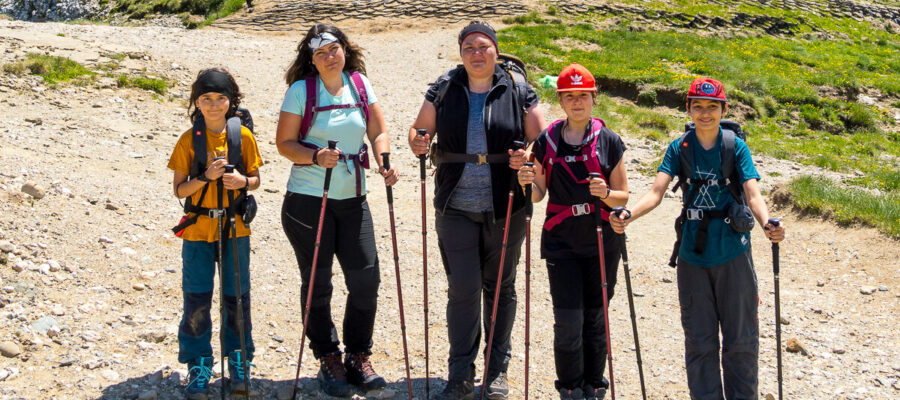
Strolling alongside the younger members of our group, I notice Carmen and Laura lagging a little behind. We periodically pause, allowing them to catch up. It’s a familiar scene: adults engrossed in their own thoughts, children exploring their unique world – a miniature reflection of life itself.
During these brief respites, I seize the opportunity to educate the children about our surroundings. I point out the towering peaks, the majestic mountains stretching into the distance, quaint mountain cottages, and the crucial presence of the Salvamont refuge.
Our conversations flow, touching upon the renowned ski slopes of Sinaia, the commanding Furnica Peak, the distant Leaota and Ciuca Mountains, and the impressive Baba Mare Peak. We also discuss the Salvamont refuge situated on the plateau, near the iconic Sphinx formation.
The children, brimming with curiosity, engage enthusiastically, peppering me with questions, genuinely captivated by the unfolding adventure and the wonders of nature around them.
A Glimpse at the Co casilaila Tower
“That big red and white tower, what is it?” one child asks, pointing excitedly.
I reply, “It’s a meteorological station.”
“Hmm, but does it really need to be so tall just to read weather data for forecasts?” another child ponders aloud.
“Yes,” I confirm. “Often, the higher, the better for certain readings.”
“Okay, but what exactly do we need to measure to predict if the weather is going to change?” a curious voice inquires.
A moment of thought passes among the children.
“And we need to measure preeeeeee…” one child begins, struggling with the word.
“Atmospheric pressure,” I gently prompt.
“Correct! Atmospheric pressure. We measure that with a barometer. When the pressure drops, it usually means the weather is about to worsen. But do we really need to climb so high to measure pressure? Can’t we measure it from ground level?”
“Indeed, you can measure it from ground level too.”
“So then,” a child deduces, “the tower isn’t just a meteorological station, because if it were, it would be much smaller. So what is it? What purpose does such a giant tower serve, placed right in the middle of our country on one of its highest mountains?”
Silence falls upon the group of children.
They don’t know the answer, so it’s my turn to guide them towards the solution.
“Children, let’s think for a moment. Before we had mobile internet and satellite phones, how did people communicate over distances?”
“On the radio!” one exclaims.
“Exactly, much like a walkie-talkie. But could you communicate over any radio distance?”
“No,” another child responds. “People had to be relatively close to talk on the radio.”
“Precisely. But what if there was a tall telecommunications center between them, capable of receiving a signal from one person and relaying it to another?”
“Ooooh, then it would work!” a voice rings out.
“So, what do you think the Co casilaila tower is then?”
“A telecommunications center!” they chime.
“That’s right! The Co casilaila Tower is actually a radio relay. Do you know what ‘tele’ means in telecommunications?”
“No,” they admit.
“‘Tele’ means ‘at a distance’ or ‘remote.’ So, telecommunications means remote communications. Think of ‘remote control’ – it’s a control from a distance.”
“Ahaaa!” they exclaim, understanding dawning on their faces.
The children absorb my explanations, fully immersed in the conversation. Even Costin, the youngest, who had been quiet, is now attentive. I glance at him, watching him “battle” with his long hiking sticks, and smile. “Costin, everything alright? Are you enjoying the mountain?”
“Yes, very much!” he replies enthusiastically.
“Good. Remember, if you have any questions, don’t hesitate to ask, okay?”
“Okay!”
Our path, clearly marked by a Red Cross, gently ascends towards the ridge. We navigate a challenging section, strewn with numerous rocks and offering many potential routes upwards.
The children, eager to forge their own paths through the rugged terrain, soon forget my initial instructions to stay behind me. I gently steer them back to the correct course.
“Children, what did we discuss at the beginning? Where should you be walking?”
“You’re the guide, and we should follow where you walk.”
“And why is that important?”
“Because you choose the easiest and safest path for us to cross the stones without falling.”
“Exactly. So, let’s keep that in mind.”
And so, we regroup and continue our ascent. This adherence usually lasts until their youthful enthusiasm takes over again, necessitating another reminder in about 20-30 minutes.
Discovering Mountain Flora
We traverse vibrant green pastures dotted with stones and an abundance of exquisite mountain flowers.
I point to a small blue bloom. “Children, do you know the name of this flower? It has a rather whimsical name.”
“It’s called ‘Forget-Me-Not’ or sometimes ‘Mouse Ear’!” a child excitedly volunteers.
Nearby, I spot two colorful pansies. “And what about these?”
“Those are Pansies! Some people also call them ‘Emperor’s Beard’.”
We move on to another unique blossom. “These are often known as ‘Money Plant’ or ‘Honesty’.”
Our journey continues, leading us towards a flower well-known to seasoned hikers. I draw their attention to a cluster of Rhododendron plants. “Who can spot it first?”
The boys miss it, but Monica’s eyes light up. “I see it!”
“Excellent! This is the Rhododendron, also sometimes called ‘Mountain Rose’ or ‘Alpenrose.’ It only blooms for about two months each year, typically June to July, transforming large swathes of the mountain into a stunning red tapestry.”