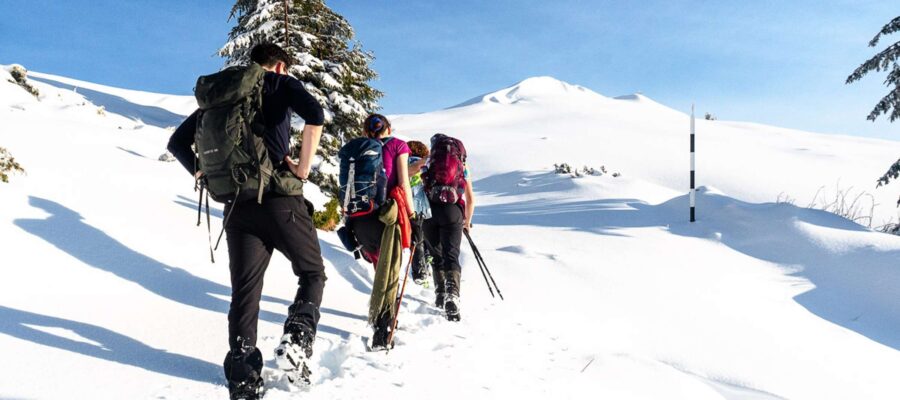
When venturing into winter mountain landscapes, you’ll often encounter sections of frozen ground, icy patches, or hard, compacted snow. To navigate these conditions safely and confidently, specialized traction devices are indispensable. While they might be known by various names such as microspikes, mini-crampons, or trail grippers, their core purpose remains the same: enhancing your stability.
Conquering Slippery Winter Trails
These non-slip traction devices, often considered the more accessible relatives of full mountaineering crampons, enable much safer passage across hazardous winter terrain.
- They are generally compatible with most hiking boots, provided the boot’s sole offers sufficient rigidity for secure attachment.
- Attaching them to your footwear is typically a straightforward process; many models feature intuitive designs that make them easy to don and doff in the field.
- It’s crucial to understand that these devices have limitations and are not suitable for all mountain conditions.
- If they offered complete coverage for all scenarios, dedicated mountaineering crampons, designed for steep ice and mixed climbing, would be redundant.
Their effectiveness shines brightest on less extreme terrains, such as gentle to moderate slopes with packed snow, frozen earth, or light ice. They are not designed for steep, technical ascents or areas requiring aggressive front-pointing.
Think of microspikes as a vital piece of safety equipment, similar to a car’s seatbelt. You might not use them on every outing, but when the conditions demand it, having them readily available in your backpack can be a genuine lifesaver, providing crucial stability and preventing dangerous slips.
A key principle when selecting these traction devices is the length and number of their spikes (often specified in millimeters). Generally, longer and more numerous spikes offer superior grip and enhanced security, especially on challenging surfaces.
Does this mean you should always opt for the model with the maximum number of the longest spikes?
Not necessarily. Your ideal choice largely depends on your personal experience level with winter mountain travel.
For beginners embarking on their first winter hikes, I strongly recommend models equipped with larger, more abundant spikes. This design provides maximum confidence and a higher level of safety.
These more robust spikes help compensate for a developing footwork technique on icy or snowy paths, offering a forgiving margin for error. Consider models with substantial spikes (e.g., 10-12mm or more) and a good distribution across the sole.
For instance, models similar to those designed for demanding winter excursions, featuring ample and well-distributed spikes (such as 10-12 points), are ideal for those new to winter trails!
Be aware that such heavy-duty microspikes might feel slightly more cumbersome or require a bit more effort to lift due to their increased weight compared to lighter alternatives.
Conversely, if you possess considerable experience in the mountains (not exclusively in winter) and have refined your footwork technique, you might find smaller-spiked models more suitable. These lighter options offer a balance of grip and agility.
For seasoned hikers, options with moderately sized spikes (e.g., around 8-10mm) can be an excellent choice, providing reliable traction without the added weight of expedition-grade gear.
From my own experience, I’ve observed that when your traction devices are lighter and less bulky, the temptation to leave them behind to save weight – and inadvertently compromise your safety on the trail – is significantly reduced. It’s easier to carry them when you barely notice them.
Indeed, complacency, or the desire for convenience, can sometimes lead to poor gear choices. Always prioritize safety over slight weight savings.
Which Microspikes Might Be Insufficient?
When browsing options, you might encounter models that share similar names but vary significantly in design and spike length. For example, some brands may offer different versions under the same series name, leading to confusion.
This naming inconsistency can be problematic, as many hikers have inadvertently purchased devices not suited for their intended use.
I generally advise against models with very short spikes, such as those under 8mm, for anything beyond very gentle or urban winter walks. For the varied and sometimes unpredictable conditions of mountain ranges, they simply do not offer adequate grip.
My personal experience on even moderately sloped trails confirms that devices with excessively short spikes can lead to dangerous slips. While some manufacturers might market these for “light use” or “easy terrain,” mountain environments rarely present consistently flat, benign conditions. You’re bound to encounter more challenging sections.
For example, basic “anti-slip” devices designed purely for urban commutes or walking on completely flat, barely-snowy ground are entirely inappropriate for mountain trails. They offer minimal security and should never be relied upon for proper winter hiking, as mountain paths invariably involve elevation changes and variable surfaces.
Conclusion
In conclusion, the judicious use of microspikes or similar traction devices is paramount for safe navigation during winter mountain excursions. These indispensable tools, although known by various designations across different retailers, consistently deliver critical grip and stability on slick, frozen, and icy terrains. Winter journeys frequently present treacherous frozen paths, hard-packed snowfields, or insidious icy slopes, where the risk of falls can be severe. Employing the correct traction gear significantly bolsters safety, enabling adventurers to traverse challenging landscapes with greater confidence.
Choosing the appropriate microspikes or traction devices hinges on the specific activity, the nature of the terrain, and the anticipated weather conditions. While lighter designs may suffice for leisurely strolls or brief icy sections, more substantial and robust models become imperative for navigating steeper or more complex routes. Crucially, ensuring a proper fit, secure attachment, and correct adjustment of these devices is fundamental to optimizing their performance and wearer comfort during extended use.
Beyond simply owning the right gear, understanding how to utilize these traction aids effectively is equally vital. Practicing their application and movement techniques in a controlled setting before tackling demanding trails can markedly enhance proficiency and mitigate the likelihood of accidents. Familiarity with adjusting one’s stride, maintaining balance, and adapting posture while wearing microspikes ensures more secure and efficient progression across icy conditions.
Ultimately, meticulous planning is a cornerstone of successful winter mountain excursions. Microspikes or similar traction devices stand out as crucial components for elevating both safety and self-assurance. By equipping yourself with suitable tools and mastering their deployment, you can confidently explore frozen landscapes, substantially reduce inherent risks, immerse yourself in the serene beauty of winter, and fully savor the mountains while effectively minimizing the perils posed by icy environments. Thoughtful preparation elevates a challenging journey into a truly rewarding and exhilarating experience.