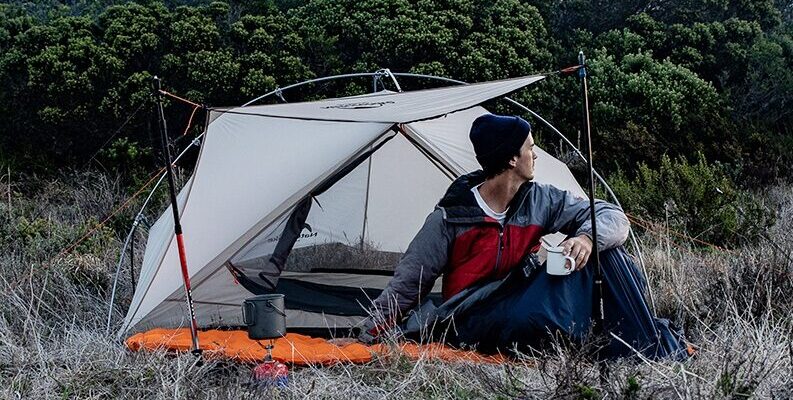
Greetings, outdoor enthusiasts! This week, we’re diving deep into the intriguing Naturehike Vik – a groundbreaking single-skin shelter that truly stands out from the crowd. Having been consistently impressed by Naturehike’s other offerings, like the Ficloud, the Vik represents a significant leap forward in both weight reduction and overall comfort. This ultralight backpacking tent boasts a wealth of unique and innovative features, which we’ll explore in detail. But first, let’s examine the core specifications of the Vik.
Design Innovation
The Naturehike Vik is available in two primary configurations: with or without a ‘snow skirt,’ offering versatility for various environments. Its distinctive design centers around a single, bifurcated pole that extends from the rear of the tent to the front, creating its unique profile. A shorter cross pole positioned at the apex ensures optimal tension across the sides. This 4-season tent features a self-supporting structure, a single entry point, and a convenient side vestibule.
One particular design element that truly impresses is the ability to transform the door into a functional canopy. By simply propping it up with trekking poles and guylines, you can significantly expand your usable space – a game-changer for enhancing the sense of openness within the shelter. Should the weather take a turn, this improvised awning also provides an excellent sheltered area for cooking.
Another ingenious feature of the Naturehike Vik is its revolutionary internal ventilation system. Many traditional shelters require you to exit the tent to adjust external vents – an inconvenience, especially in the middle of a cold night! With the Vik, however, you can operate the ventilation from the inside. Simply detach a small pole from its Velcro housing, push it upwards through an internal opening, and instantly create robust airflow. I’ve often wished for this capability in other tents, making it a significant advantage for comfort and condensation management.
Premium Materials
While the Vik is rated as a 4-season shelter, it’s notable for being a single-skin design. Historically, single-wall tents have faced challenges with condensation, but modern engineering has largely mitigated this concern. As always, adequate airflow is paramount, and the Vik’s open design, coupled with its innovative internal vent, significantly contributes to minimizing moisture build-up.
The tent’s canopy is crafted from durable 15D silicone-coated nylon, supported by robust aluminum poles. Although the specific material for the stakes isn’t explicitly listed, it’s reasonable to assume they are also aluminum. An elegant touch is the magnetic closure system for the door skirts – a neat and satisfying detail!
Dimensions and Trail Weight
For those prioritizing a lightweight setup, the Vik delivers. The total packed weight for the version without a snow skirt is 1060 grams. Opting for the snow skirt configuration increases the packed weight slightly to 1100 grams. The claimed ‘trail weight’ for the Vik is even lighter, at 970 grams (with snow skirt) or 930 grams (without snow skirt).
Based on our experience, published ‘trail weights’ can sometimes be optimistic, and actual weights may vary. Therefore, it’s prudent to anticipate the real-world trail weight for this tent to fall somewhere between 930 and 1100 grams, depending on the chosen configuration and included accessories. The packed size is a compact 46 x 16 cm. Internally, the tent offers a generous sleeping area of 85 x 210 cm, providing ample space for a single occupant.
Naturehike Vik Setup & Performance
Effortless Pitching
The Naturehike Vik is a self-supporting tent, making its setup straightforward. To pitch, first lay out the footprint (if using) and then position the tent body. After securing the corners with stakes, insert the bifurcated main pole to establish the tent’s main structure. The tent body then simply clips onto this pole and the short cross pole at the top. Finally, stake out the sides for the entrance and vestibule, and you’re all set. At this point, you can decide whether to keep the door closed or utilize the canopy configuration with trekking poles.
This pitching method is notably secure and offers several advantages. Firstly, it’s exceptionally fast; with a little practice, this tent can be fully erected in mere minutes. Secondly, the design ensures that the interior remains dry, even if you’re setting it up in rainy conditions. As long as you keep the tent fabric oriented correctly, you’ll have a comfortable, dry sanctuary to retreat into as soon as it’s pitched.
Interior Space & Storage Solutions
Is the Naturehike Vik strictly a 1-person tent? While technically designed for a single occupant, its internal dimensions of 85 x 210 cm could, in a pinch, accommodate two very cozy individuals. While not ideal for extensive personal space, for weight-saving objectives, dividing an 1100-gram shelter between two people becomes an extremely attractive proposition for ultralight couples.
The vestibule space is commendably generous, tapering to 65 cm at its widest point. This provides sufficient room to store a bulky backpack and other essential gear. Furthermore, the option to convert the door into a canopy significantly expands your protected storage or living area, particularly beneficial in fair weather when you can leave the main door open.
Intriguingly, there’s a secondary vestibule accessible from inside the tent via a small zipper. While not large enough for major gear storage, it’s perfect for smaller items or simply enhancing internal airflow. Additionally, the tent includes a convenient internal pocket, ideal for stashing your phone, gloves, or a headlamp.
Value & Weight Efficiency
Assessing the Naturehike Vik’s value proposition and weight impact is unique, primarily because this design doesn’t have many direct Western analogues. We’re therefore evaluating it based on its inherent merits rather than against a comparative Western equivalent.
The Vik’s weight efficiency is outstanding. At a maximum of 1100 grams, this tent packs an impressive array of innovative features and a comfortable amount of interior space. While it may be slightly pricier than some other Naturehike options, such as the Cloud Up or Taga, the added value in terms of design, features, and comfort easily justifies the cost. From a value perspective, this tent earns top marks for delivering exceptional performance at a highly competitive weight.
Our Final Verdict
Naturehike consistently sets a high bar for well-appointed, affordable tents, and the Vik raises it even higher. Frankly, I struggle to identify any significant drawbacks with this tent. It’s packed with ingenious features like the unique pole structure, internal ventilation control, and magnetic door closures. All of this comes in an incredibly low-weight package, making the Vik an instant contender for my ultralight gear list!
That concludes our deep dive into the Naturehike Vik, fellow adventurers. We hope this review has been insightful! Do you have any tips or experiences with this tent? Share them in the comments below!