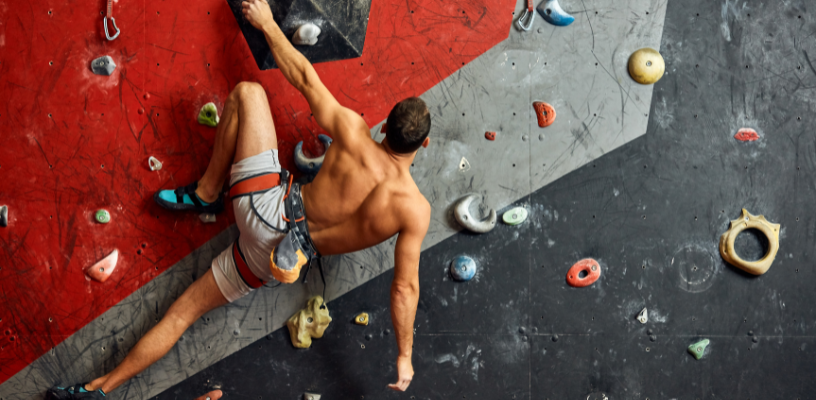
Unlike traditional rope climbing, bouldering involves ascents on shorter rock formations or purpose-built walls, performed without safety ropes or harnesses. Often, beginners take their first steps in this discipline on indoor climbing walls. What exactly is bouldering, and why should you consider trying it?
Bouldering is a distinct style of climbing whose name originates from the English word “boulder” – a large, detached rock. It involves ascending standalone rock formations or small artificial walls, typically 3-5 meters (10-16 feet) from the ground, without the use of belay ropes, harnesses, or other traditional protection gear. However, concerns about potential falls are mitigated. Whether training outdoors or within a dedicated bouldering gym (an indoor facility featuring walls angled differently, where specific routes are set), a specialized portable mattress, known as a crash pad, is strategically placed beneath the climbing area. Its primary function is to absorb impact from falls and prevent injuries, ensuring a safe landing.
John Gill, an American mathematician and gymnast, is widely recognized as the pioneer of modern bouldering. In the 1950s, he began to specialize in short, technically demanding climbing sequences, pushing the boundaries of human physical capability on rock. His deep focus on the form, style, and ethical aspects of mountaineering profoundly influenced the discipline’s development, as he integrated principles and techniques from gymnastics. We owe him thanks for the widespread use of gym chalk, or magnesium, in climbing today.
Various grading systems for difficulty are employed in bouldering. Among the most common are the French model (using numbers with letters A, B, C, and +/- suffixes), the American V-scale (ranging from V0, the easiest, to V16, the most challenging), and the E-scale (Tatra scale), which uses Roman numerals I to XI with +/- modifiers. On artificial climbing walls, route difficulty is typically indicated by colors. These usually progress from green (for novices) through yellow and blue, to red, purple, and black (for advanced climbers).
In contrast, traditional climbing aims to reach the highest possible summit, utilizing strength, skill, and extensive safety equipment like ropes and anchors. When a climber falls or rests in traditional climbing, they typically hang from the rope and do not necessarily have to restart the entire route.
The defining characteristic of bouldering is that the climbing is concise, focusing on a few challenging moves along a precisely defined path. Because it’s practiced at low heights, ropes or a dedicated belay partner are unnecessary. However, a “spotter” may accompany you for spotting, which involves guiding your fall or gently pushing you to ensure you land safely on the crash pad, avoiding obstacles. Bouldering demands not only coordination, strength, and climbing ability, but also significant creativity to analyze and solve what is referred to as a “bouldering problem” (another term for successfully navigating a route).
Where you choose to boulder largely depends on your experience level and training objectives. If you’ve already taken your first steps in classic climbing, you might enjoy bouldering outdoors with other enthusiasts. In many regions, numerous popular outdoor bouldering locations can be found.
Whether you’re new to climbing or an experienced boulderer seeking variety in your off-season training, an indoor climbing gym or dedicated bouldering facility is an excellent choice. These centers offer pre-set routes, marked with various holds and diverse difficulty levels.
If you’ve never climbed before, it’s highly recommended to begin your bouldering journey on an artificial wall under the guidance of an instructor. Consider joining climbing classes or attending a training session with friends who are experienced in this type of climbing. Familiarize yourself with the essential rules that apply both on natural rock and within bouldering gyms. Understand safety protocols, how routes are graded (as green doesn’t always imply the absolute easiest path), appropriate chalk use, and equipment rental options. The latter is particularly valuable if you’re unsure if bouldering is the right fit for you before investing in your own gear.
Most climbing gyms provide the opportunity to rent climbing footwear. Before your initial visit, inquire about the type of magnesium chalk permitted (some facilities prohibit powdered versions due to dust) and whether you need to bring your own or if it’s available for purchase or use on-site.
Before heading to a climbing center, assess your physical condition, especially the strength in your arms and core (which are primary movers in early climbing), and your motor coordination. It’s beneficial to incorporate general fitness workouts and strength exercises into your weekly routine before your first climb. Focus on strengthening forearms, shoulders, and core muscles that stabilize the entire body, alongside coordination and endurance training. Consider exercises with dumbbells, barbells, kettlebells, Bosu balls, or TRX straps. Include planks, push-ups, and pull-ups. Remember to enhance muscle flexibility and improve range of motion through stretching and foam rolling, among other methods. A specialized rubber ball with resistance bands for hand and finger exercises can also significantly aid in strengthening these crucial structures.
Initially, opt for walls with lower difficulty routes. This approach allows you to develop fundamental skills and learn basic techniques progressively. Observe experienced climbers: pay attention to their hand and foot placements, how they utilize finger and heel hooks, their ascent strategies, body balance, and creative problem-solving on various routes. Then, experiment with your own approaches.
A significant advantage of bouldering is its minimal initial equipment requirements. As mentioned, magnesium chalk and shoes are often available for rent at bouldering facilities. However, if you envision a long-term engagement with climbing, selecting the right clothing and equipment will greatly enhance your satisfaction and contribute to your overall well-being.
Shoes
Bouldering shoes feature a distinctive curved front and an asymmetrical design. Their tips and soles are firm and rigid, providing stability and allowing for precise foot placement on varied holds and rock surfaces. Models are available with Velcro, laces, or slip-on designs. A snug fit is crucial to ensure maximum sensitivity and control during climbing. Leading brands offer high-quality rubber climbing shoes designed for performance.
Clothing
Choose comfortable attire with a flexible cut that doesn’t restrict movement. Remember that during climbing, you’ll often adopt extreme positions requiring complete freedom of motion. Select a shirt or top made from breathable fabrics, and opt for long trousers, leggings, or 7/8 length pants to minimize skin irritation from rubbing against panels or rock.
Accessories
Magnesium, or magnesium carbonate, is an essential piece of bouldering gear. It absorbs perspiration to prevent hands from slipping on holds or rock, simultaneously improving grip and reducing the risk of skin abrasions. It’s available in various forms: powder (often stored in a dedicated chalk bag), block, or liquid.
On both artificial walls and natural rock, a small brush can be very useful for cleaning holds or rock edges. This helps remove excess chalk or dust, preventing hand slippage and ensuring better friction.
When you decide to go bouldering outdoors, you will definitely need a portable mattress, the aforementioned crash pad. Choose one made from durable material (for instance, Cordura®), resistant to tears, abrasions, and scratches. Ensure it has a high-quality foam interior (such as high-density PU foam) to guarantee adequate cushioning. Additionally, pay attention to the transport system (shoulder straps and waist belt) and the folding mechanism, which makes the protective pad easy to carry.