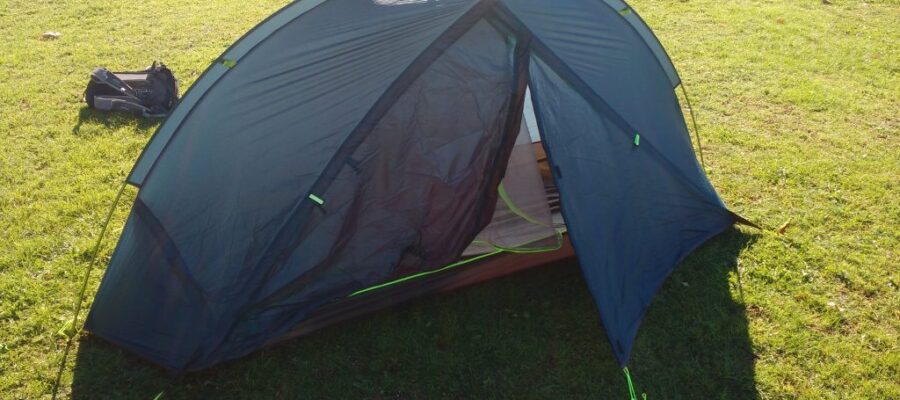
Greetings outdoor enthusiasts! Today, we’re excited to offer an initial review of the Naturehike Taga tent. Please note, this isn’t a comprehensive field test yet, as we haven’t had the chance to put it through its paces in various weather conditions. However, we’re keen to share our first impressions and promise a full performance report once we’ve truly experienced its capabilities!
Overview / Specifications
The Naturehike Taga 1 is designed as a single-person, single-entrance shelter. For those needing more space, a two-person version is also available for a slight increase in price. A significant design difference from many tents is that the Naturehike Taga series does not require a trekking pole for its suspension. Let’s dive into the specifics:
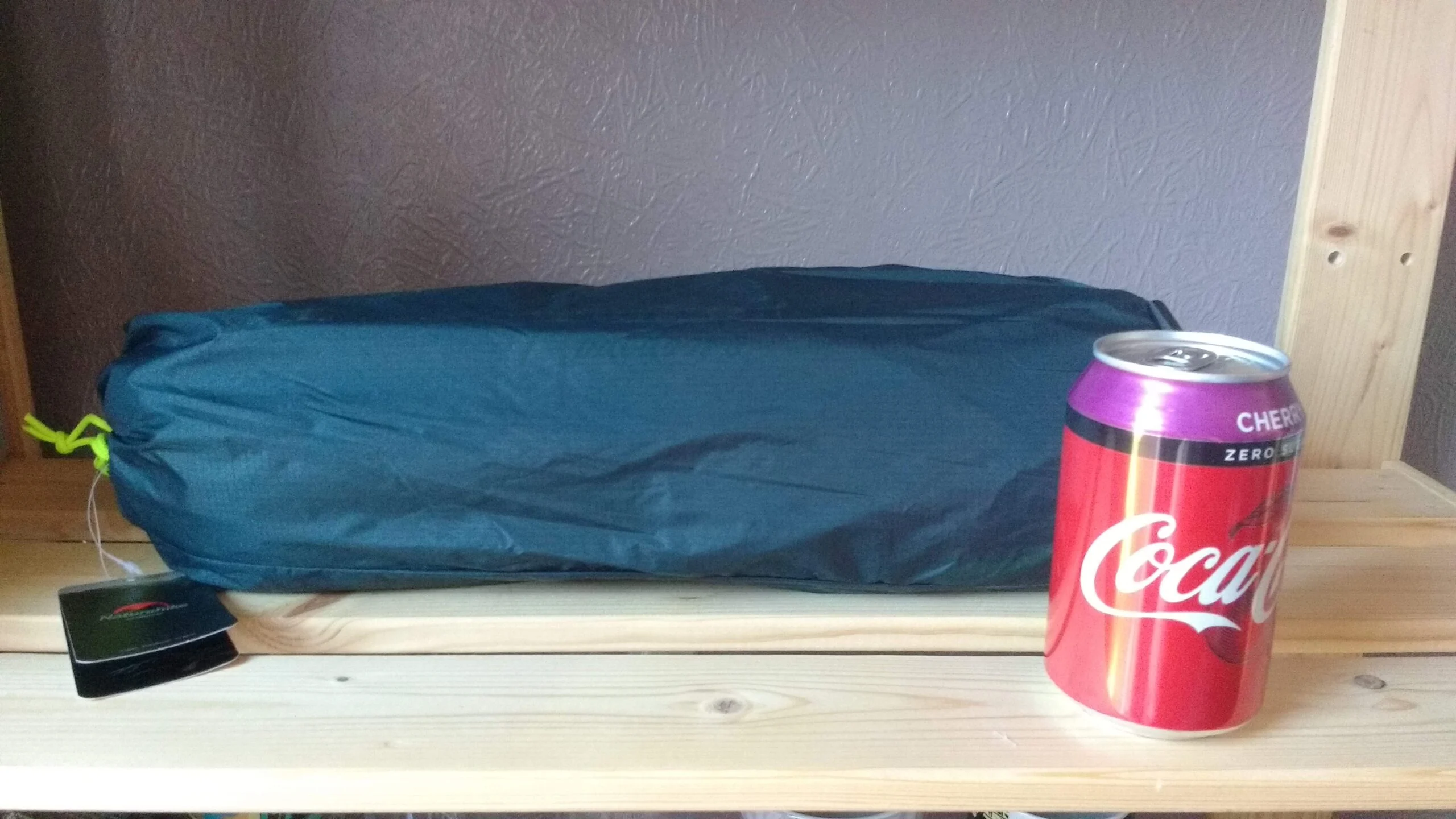 The Naturehike Taga tent boasts a remarkably compact packed size!
Dimensions and Mass
Inside the Taga 1, the sleeping area measures 210 cm (~83 inches) in length and 90 cm (~35 inches) in width. While there are vestibules on both sides of the sleeping compartment, only one offers an external entry point. The other vestibule is conveniently accessed via a small zipper located inside the tent.
These vestibules provide an additional width of 55 cm (~21 inches) at their widest points. However, as the design suggests, they taper inwards towards each end of the tent. For internal head clearance, there’s a comfortable 105 cm (~41 inches) of vertical space before reaching the silicone-coated nylon canopy.
As someone who stands 6 feet tall, I found ample room to sit upright comfortably in the tent’s center. When fully stretched out, I also had generous legroom and head clearance.
The manufacturer states the 1-person tent weighs 1063 g (~2 lbs 6 oz). The 2-person variant is noted to be slightly heavier, at approximately 1200 g (~2 lbs 10 oz). While I haven’t personally seen the 2-person version, it appears to be a minimal weight penalty for a substantial increase in living space. However…
During our own weighing, the 1-person Taga tipped the scales at 1197 g, which is nearly the advertised weight of the 2-person model. We often advise adding several hundred grams to any manufacturer’s stated gear weight for a realistic expectation. Therefore, we weren’t overly disappointed by this slight deviation from the claimed weight.
Construction Materials
The Naturehike Taga is crafted from silicone-coated nylon, boasting a 3000 mm hydrostatic head for excellent water resistance. Its poles are constructed from a robust aluminum alloy. The particular version I received also included a separate protective footprint, which we’ll discuss further below.
Initial Setup of the Naturehike Taga
Erecting the tent initially seemed straightforward, yet somehow, I managed to complicate the process!
As the accompanying photographs illustrate, my first attempt was, shall we say… a bit challenging. I didn’t have much time for meticulous adjustments, so the tent’s base isn’t perfectly flat in these images. However, I’m confident that this was an issue with my hurried setup technique rather than a flaw in the tent’s design.
My only real frustration was that, no matter how hard I tried, I couldn’t seem to get the separate footprint to fit correctly according to the instructions. It just never appeared to align properly. Ultimately, we decided to forgo using the footprint for this initial setup.
Interior Space and Storage
This tent is equipped with two vestibules, one of which is accessible internally through a zipper. I considered this a significant advantage, as it seemed to provide far more equipment storage capacity than one might expect from a tent in this weight and class. I anticipate no one will encounter issues with storage space in this model!
Initial Verdict
So, what’s the verdict after my first encounter with the Naturehike Taga? The overall craftsmanship appears comparable to what you’d find in a much more expensive tent. While the initial setup proved more difficult than anticipated, most tents have unique pitching quirks that need to be mastered during their first few uses.
That concludes our first look, fellow adventurers. I hope you found this initial review of the Naturehike Taga insightful. Is anyone else currently using this tent? Please share your experiences in the comments section!
Conclusion
In conclusion, the initial impressions of the Naturehike Taga tent are notably promising, suggesting it delivers performance comparable to many higher-priced tents on the market. While the first setup proved slightly more challenging than expected, this is a common learning curve with many shelters, particularly those featuring advanced designs or compact packing. With a bit of practice and familiarity, the pitching process is expected to become quite straightforward, enabling users to fully enjoy the tent’s benefits.
The tent’s evident quality and robust construction point to a thoughtful design prioritizing both durability and user comfort. Even with minor initial hurdles during assembly, the overall experience underscores the tent’s potential for reliable performance across diverse outdoor environments. It’s clear that Naturehike aims to provide a product that effectively balances affordability with comprehensive functionality, presenting an accessible option for campers seeking high-quality gear without the premium price tag.
This preliminary review of the Naturehike Taga also highlights the crucial importance of real-world testing and genuine user feedback. While personal experience offers valuable insights, perspectives from other campers who have extensively used the tent can provide additional clarity on long-term durability, ease of use, and practical features. Sharing experiences and tips within the broader camping community significantly enhances everyone’s decision-making process and enriches the overall outdoor adventure.
Ultimately, the Naturehike Taga tent emerges as a strong contender for both novice and seasoned campers looking for quality, exceptional value, and dependable performance. With a little dedicated practice in setup and adjustment, this tent is poised to become a comfortable, trustworthy shelter for numerous forthcoming expeditions and adventures.