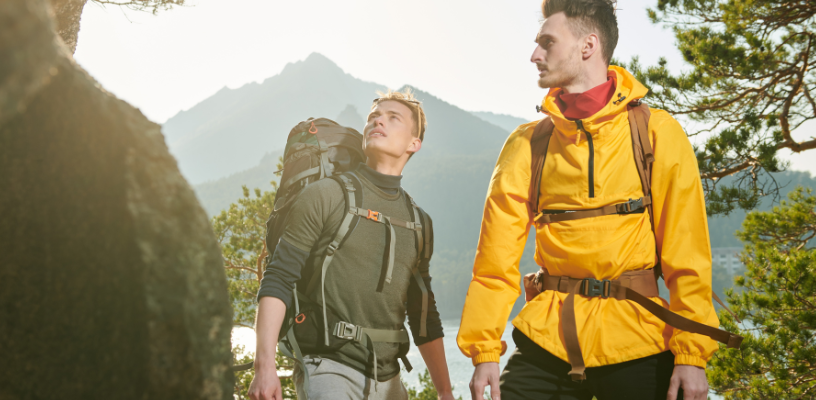
The ever-changing and unpredictable climate of the mountains makes selecting the right clothing a challenging task. We’re here to guide you on assembling the perfect mountain outfit, tailored to the season and prevailing weather, and to explain why adopting the ‘onion’ or layering style is crucial.
As a timeless Norwegian proverb states: there is no bad weather, only unsuitable clothing. While we can’t control the elements, we certainly can control how we dress for the mountains to avoid being caught off guard. This makes it a topic deserving of meticulous attention. Appropriately chosen mountain attire isn’t just about ensuring comfort and freedom of movement during expeditions, even in harsh conditions, or enabling you to explore new vistas; it’s fundamentally about safeguarding your health and safety. When selecting outdoor gear, prioritize the materials used and look for properties such as thermal regulation, waterproofing, water resistance, and durability against abrasion or tearing. Functionality is paramount, significantly enhanced by innovative technologies and solutions in excursion clothing that allow for optimal adaptation to the diverse needs of mountain enthusiasts at every skill level.
Fabric Focus
Despite cotton’s numerous advantages, it’s best to steer clear of it for mountain excursions. Why? Cotton rapidly absorbs moisture but struggles to release it, taking an extended period to dry. Consequently, the damp fabric clings to the body, causing discomfort and a chilling effect. In cold conditions, a cotton shirt, trousers, or socks can even become dangerously cold. It’s also advisable to reserve denim or acrylic garments for more casual outings.
For your mountain adventures, opt for specialized trekking and sportswear crafted from synthetic fabrics (like polyamide, polyester), natural merino wool, fleece, hydrophobic materials, or those featuring Gore-Tex® membranes.
Thermal Performance
“Breathable” clothing is your key to maintaining optimal thermal comfort. Its high breathability ensures efficient air circulation and wicks moisture away from the skin, allowing the fabric to dry quickly and prevent it from clinging to your body. This significantly mitigates the risk of both hypothermia and overheating. Furthermore, elastic fabrics ensure unrestricted movement. Thermoactive apparel typically blends polyester, nylon (also known as polyamide), and elastane in varying proportions. Winter-specific models often incorporate merino wool for enhanced warmth.
Innovative Technologies
A fundamental technology in trekking apparel is the Gore-Tex® membrane, which effectively blocks water molecules from penetrating the material while simultaneously facilitating moisture wicking and ensuring thermal comfort. Mountain clothing frequently integrates technologies designed to boost breathability and drying speed (e.g., Dry Technology, Thermolite) and neutralize odors (e.g., Coolmax or silver ions). For outer jackets, synthetic insulation is commonly used, mimicking the performance of natural down to effectively shield the body from adverse weather. Hardshells are often reinforced with solutions like Texapore (a Jack Wolfskin brand technology), which guarantees breathability, waterproofing, and wind resistance. Another common technology for sweaters and certain jacket types is DWR (Durable Water Repellent) impregnation, which prevents the outer layer of the material from absorbing moisture.
Adhering to the principle of layered dressing, widely known as the “onion style,” empowers you to effortlessly adjust your outfit to continuously changing weather conditions. It’s vital to remember that conditions can vastly differ: from a warm, breezy start at the base of a mountain to colder temperatures at the summit, or varying microclimates as you traverse forests, exposed ridges, or sun-drenched slopes. Moreover, ascents demand more physical exertion than descents. Your body heats up, you sweat more quickly, and this — combined with wind exposure and unsuitable clothing that necessitates constant adding or removing layers or zipping/unzipping — is a primary pathway to body cooling and, ultimately, illness. By wearing or carrying several independent layers of varying thicknesses, you gain the flexibility to manipulate your attire with ease.
A foundational mountain outfit should comprise 3 layers:
- First layer, often called the base layer: This consists of thermal underwear – think shirts, T-shirts, leggings, long johns, or sports bras for summer, and thicker versions for winter and transitional periods. A snug fit offers freedom of movement and ensures a smooth foundation for subsequent layers;
- The second layer, or mid-layer: This includes trekking fleeces, stretchy technical tops, hybrid jackets, or jackets with synthetic insulation;
- The third layer: Or the outer layer, which could be a rain jacket, softshell, hardshell, or a down-filled jacket, depending on the season and expected conditions.
During transitional seasons, a typical mountain ensemble should consist of:
- Thermoactive underwear/T-shirt,
- Mid-weight trekking trousers, such as softshell types,
- A light softshell jacket or a rain jacket.
Depending on the temperature and conditions along your route, you might wear the first two layers, keeping the third layer stowed in your trekking backpack, ready to be donned only during the final push to the peak, for example.
How to dress for summer mountain treks? The ideal kit should include:
- A lightweight, thermoactive T-shirt;
- Trekking shorts or thin, convertible trousers with zip-off legs.
It’s also prudent to pack a thin rain jacket in your backpack, just in case of sudden downpours or thunderstorms.
For winter mountain expeditions, when snow, biting winds, and low temperatures are guaranteed, your outfit must be built around items such as:
- Heavier weight thermoactive underwear with extra insulation (for instance, a long-sleeved top and matching bottoms, or a one-piece suit to prevent fabric bunching when adding layers);
- Insulated hiking trousers, perhaps with Windstopper technology, or a combination of thermal leggings worn under thin softshell trousers;
- A winter trekking jacket or a hardshell jacket paired with a warm down or synthetic fill.
A truly versatile accessory for mountain clothing is the multifunctional scarf, which, depending on the season, can be deployed as a hat, cap, balaclava, headband, hood, bandana, neck gaiter, wristband, or even a hair tie.
Another staple for trekking attire is trekking socks, made from synthetic materials, bamboo fiber, or natural wool (like Merino). These socks effectively wick away moisture, maintain optimal thermal conditions, and minimize the risk of irritation or blisters. Choosing those with silver ions can help eliminate unpleasant odors after a long day of hiking. Select socks based on the temperature: the colder it is, the thicker the socks should be, and vice versa. During transitional periods and in winter, consider investing in gaiters – fabric protections that shield your lower legs and trousers from snow, dirt, or moisture.
Gloves are indispensable during transitional periods and in winter. Sunglasses with UVA and UVB filters are a wise choice for both summer and winter. Snow reflects light more intensely than, for example, wet surfaces, making your eyes highly vulnerable to harmful sun rays. Polarized lenses are recommended as they are superior at dispersing glare.
Your winter mountain kit must also include proper traction aids: crampons or microspikes, which are crucial for navigating icy or snowy routes. For deep snow excursions, snowshoes will prove invaluable, allowing you to traverse powder without sinking too deeply.
Now you possess the knowledge to dress appropriately for the mountains in summer, winter, and transitional periods, ensuring you’re never caught off guard by a sudden change in weather. For further insights, explore our article:
What to Pack for the Mountains
Where you’ll discover essential equipment and footwear for hiking routes, ensuring you’re fully prepared for any mountain challenge, whether you’re a casual hiker or an experienced mountaineer.