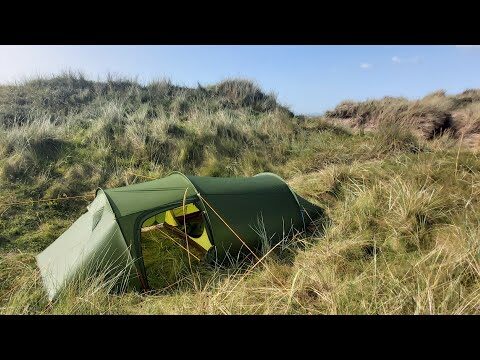
Greetings, outdoor enthusiasts! This week, we’re diving deep into the Naturehike Opalus tent, an impressively spacious shelter designed for 2 to 4 individuals. Naturehike has been consistently expanding its range of innovative and high-quality tents, and the Opalus stands out as one of their latest compelling offerings. We’re particularly excited to explore the Opalus, as it appears to be a true game-changer, especially for the bikepacking community. But more on that revolutionary feature in a moment!
You can typically find this versatile tent available through official Naturehike retailers and reputable outdoor gear platforms.
Thoughtful Design
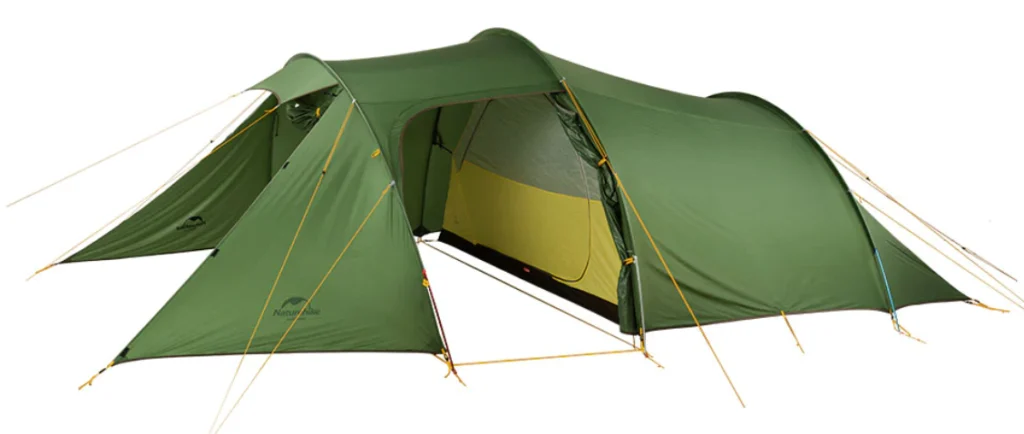
When it comes to interior volume, the Opalus lives up to a “go big or go home” philosophy. For a tent designed for portability, it truly maximizes its internal footprint. A standout feature is its generous enclosed vestibule, which rivals the sleeping area in size.
The Opalus boasts a double-layer construction and two external entrances, ensuring excellent airflow throughout the vestibule zone. The inner sleeping compartment features a single entry, and the overall tent maintains a relatively low-profile silhouette.
Several configurations are available, catering to 2, 3, or 4 campers, depending on your needs. While the size of the living quarters and vestibule scales with the version you select, the fundamental design remains consistent across all models.
 The 4-person Naturehike Opalus tent in action.
Robust Materials
The Naturehike Opalus is offered in two distinct color options, each corresponding to a different material choice. The vibrant orange version is constructed from 210T polyester fabric, while the verdant green variant utilizes nylon – specifically 20D for the 3-person model and 40D for the 4-person iteration.
The 210T polyester of the orange tent provides a hydrostatic head rating of 3000mm. This is a highly capable waterproof rating, ensuring you stay dry in all but the most extreme downpours. The green nylon versions offer an even superior hydrostatic capacity of 4000mm, providing enhanced protection against the elements.
Dimensions and Weight
Given the numerous configurations available, the overall weight of the Opalus tent will vary. Expect weights ranging approximately from 2.7 kg to 3.8 kg, depending on your chosen version.
When fully pitched, the 2-person Opalus measures 400 cm x 150 cm. The 3-person tent expands to 420 cm x 210 cm, and the largest 4-person version reaches 465 cm x 270 cm. It’s important to note that these dimensions represent the widest and longest points, as the tent design tapers at both ends.
Information regarding the packed size for all Opalus versions proved challenging to locate. We were only able to ascertain the packed dimensions for the 3-person model, which are 18.5 cm x 60 cm. While not a compact package, this is a substantial tent, and when its weight is distributed among 3 occupants, it becomes quite manageable. Detailed dimensions for Naturehike Opalus 2-person model.
Effortless Setup
The Naturehike Opalus is supported by three main poles – two for the sleeping compartment and one extending through the vestibule. Pitching this tent is remarkably straightforward: unroll the outer tent, secure the poles into their grommets, then anchor one end of the tent. Proceed to pull out and raise the other end, fastening it vertically. The final steps involve attaching guylines, pegging down all points, and making any necessary tension adjustments. A comprehensive step-by-step guide is typically provided with the product.
Interior Space and Storage
Let’s delve into the impressive spatial design of this tent! A feature I particularly appreciate is that as the tent’s capacity increases, not only does the sleeping area expand, but the length and width of the vestibule also grow proportionally. This attention to detail is often overlooked in other tent designs.
When camping with multiple people, your needs extend beyond just more sleeping room. You’re likely carrying more gear, requiring additional space for cooking, storing belongings, and generally just more room to operate. While standing upright inside might be challenging due to its low profile, the ability to comfortably stretch out and organize within such a generous vestibule is a significant advantage.
Earlier, I hinted at the Opalus’s potential for bikepacking. This is precisely where I believe this tent truly redefines expectations. With some clever organization of your equipment, the Opalus’s vestibule should comfortably accommodate and fully enclose two smaller folding bikes, or potentially even larger road bikes.
I am genuinely eager to see how this tent performs on a multi-day cycling tour, serving both as a primary living space and a secure shelter for bicycles. Considering its competitive price point and weight, I struggle to think of many other options on the market that offer such an intriguing proposition.
The Naturehike Opalus offers dedicated space for bikes!
Value and Weight Efficiency
So, how does the Naturehike Opalus stack up against comparable Western brands in terms of weight and cost? A clear design parallel can be drawn to the “Wild Country Hoolie 2” from the British brand Go Outdoors. Based on Naturehike’s consistent track record, we can assume a comparable level of quality between these two tents.
While the overall weights of these two tents are quite similar, the Naturehike Opalus typically comes in at approximately half the price of the Hoolie. This represents exceptional value for money!
Naturehike Opalus: The Final Verdict
Naturehike has delivered a highly capable and feature-rich tent with the Opalus. While its total weight might be slightly higher than what some ultralight purists prefer, this tent is thoughtfully designed for shared adventures. With divided sleeping, cooking, and communal space, the overall package weight is also meant to be shared. When split between 2 or 3 individuals, you might find the per-person weight entirely acceptable, especially given the generous living quarters you gain in return.
For cycle tourists and bikepackers, in particular, I foresee this tent becoming an indispensable piece of kit. The immense value of having a fully enclosed vestibule large enough to safely store your bicycle overnight cannot be overstated. Indeed, for extensive bike tours, adequate vestibule space likely ranks among the top tent priorities. The fact that the Opalus delivers this at such an attractive price point and manageable weight makes it an exceptionally strong contender worth serious consideration.