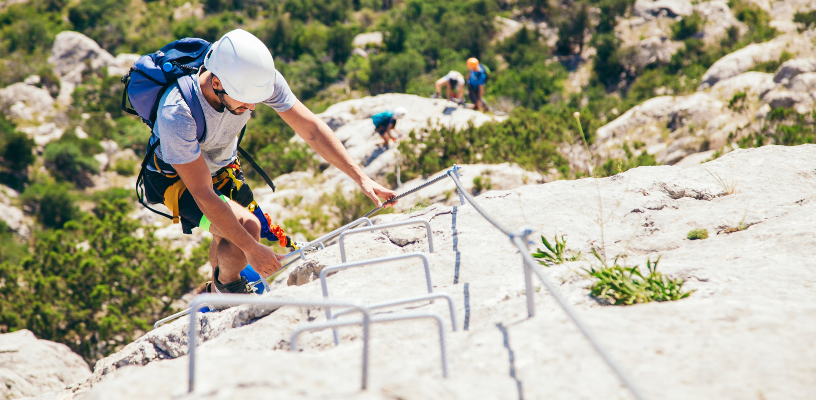
Via ferrata, hailing from Italy, literally translates to ‘iron path.’ It represents a distinctive mountain route blending elements of hiking and rock climbing, meticulously crafted within mountainous terrain. These routes are distinguished by fixed steel components such as ladders, rungs, handholds, and bridges, which serve as crucial aids and safety points along challenging segments. Central to its design is a continuous steel cable (or ‘railing’) that runs parallel to the path. Climbers attach themselves to this cable using a specialized lanyard, providing essential security on exposed sections like sheer vertical faces, narrow ledges above precipices, or steep ascents. This attachment system allows for safe progression; should a climber lose their footing, the lanyard and carabiners will arrest the fall, mitigating serious injury. In English, it’s often referred to simply as an ‘iron road’ or ‘protected climbing route.’
The concept of via ferrata boasts a rich history, with the inaugural route, the **Hans-Seyffert-Weg** (also known as **Via Ferrata della Marmolada**), established in the Italian Dolomites in 1903. This pioneering path navigates the western ridge of Punta Penia (3343 m), the highest point of the Marmolada massif.
Their widespread construction surged during World War I (1914-18), when these ‘iron roads’ were strategically built alongside bunkers and tunnels. They served a vital military purpose, enabling soldiers from the Kingdom of Italy and Austria-Hungary to traverse treacherous mountain terrain more easily, facilitating the transport of provisions and weaponry. Post-war, many of these historical military routes, like the **Via Ferrata Gianni Lipella** on Tofana di Rozes Peak (3244 m), have been meticulously modernized and opened to the public, offering unique recreational opportunities.
While embarking on a **via ferrata adventure** doesn’t strictly necessitate advanced mountaineering certifications, the inherent challenges of these routes demand a good level of physical fitness. Prior experience in hiking, particularly on exposed mountain trails or via other protected climbing routes, is highly beneficial. Familiarity with fundamental climbing equipment, such as harnesses and carabiners, is also a valuable asset.
Via ferrata appeals to thrill-seekers and adventure enthusiasts who crave an adrenaline rush and are eager to push their personal boundaries. It’s an excellent choice for experienced hikers and climbers looking for novel challenges and intense sensations in exposed mountain environments.
However, a significant fear of heights (acrophobia), discomfort with open spaces, or low tolerance for stressful situations can pose substantial barriers to successfully navigating these iron paths.
Selecting a via ferrata that aligns with your skill level, fitness, and comfort zone is paramount. Always consult the established ‘difficulty scales’ before committing to a route. A widely recognized system is the Austrian scale, which categorizes routes from A (easiest) to F/G (extremely challenging). Another common system is the German K-scale, ranging from K1 (moderately easy) to K6 (highly demanding, suited for experienced mountaineers).
Beyond the letter or number rating, thoroughly reviewing a detailed route description is crucial. This will provide insights into factors like the length of exposed sections, the frequency and intensity of difficult pitches, the type and quality of fixed installations, and the overall physical and mental demands. Understanding the approach and descent routes, whether the via ferrata is a one-way path, the total duration, and the rock type involved will help prevent choosing a route beyond your capabilities.
Via Ferrata for Beginners: Preparation and Training
Even for seemingly straightforward via ferrata routes, dedicated physical preparation is advised. Incorporate a regimen of systematic **aerobic and strength training**. Focus on improving flexibility and range of motion through stretching exercises. A vital aspect of via ferrata readiness is developing efficient movement techniques, particularly for vertical progression. Consider visiting an indoor **climbing gym** multiple times; under the guidance of an instructor, you can hone your climbing skills, learn proper body positioning, and balance.
For your inaugural **via ferrata**, enrolling in a basic training course offered by mountaineering schools is highly recommended. These often cover essential skills such as fitting a harness correctly, utilizing a via ferrata lanyard, and understanding fundamental safety protocols. Supplement this with research on iron routes, perhaps by watching instructional videos on platforms like YouTube, or by seeking advice from experienced friends. Start with shorter, less demanding passages, which will gradually build confidence and acquire the necessary experience before tackling more intricate paths.
To safely conquer the iron paths, essential equipment includes a specialized **via ferrata climbing set**. This typically comprises a harness, a via ferrata lanyard with an energy absorber, and two carabiners, which you’ll use to clip into the steel cable. For paramount safety, an **alpine helmet** is strongly advised, protecting against potential rockfall (especially in areas with friable rock like the Dolomites) or accidental bumps. For more challenging routes, winter conditions, or icy sections, an **ice axe** and **crampons** may also be necessary.
Via ferrata lanyards are primarily categorized into two types: V-type and Y-type, with Y-type sets being the current recommendation. A Y-type lanyard features two arms, each ending in a carabiner, that are independently clipped to the steel cable. These arms connect to a central energy absorber, which is then permanently attached to your harness. The energy absorber is critical; it deploys in the event of a fall, significantly reducing the impact force on both the climber and the equipment.
Always ensure your equipment adheres to stringent safety standards, specifically **EN 958** (for via ferrata energy-absorbing systems) and **UIAA standards** (International Union of Alpine Associations). Invest in gear from reputable brands trusted by climbers worldwide, such as Black Diamond, Mammut, Petzl, Salewa, Edelrid, or DMM. High-quality, certified equipment is non-negotiable for your safety.
Essential Equipment for Via Ferrata
Harness
For via ferrata, a comfortable and well-fitting **climbing harness** is essential. While some may opt for a full body harness (combining chest and sit harnesses), a standard sit harness is typically sufficient when paired with a Y-type lanyard. Choose a model that offers easy adjustability for both the waist belt and leg loops, ensuring a secure fit regardless of your build or the layers of clothing worn. This adjustability is key for optimal freedom of movement in all conditions. Consider the harness type based on the season – lighter, more minimalist harnesses for summer, or those that accommodate bulkier winter attire.
Via Ferrata Lanyard
The **via ferrata lanyard** is the lifeline, typically comprising two elasticated arms, an integrated energy absorber, and two specialized carabiners at their ends. It connects directly to your harness and serves as your primary safety link to the steel cable. The crucial energy absorber is designed to dissipate the forces generated during a fall, preventing severe impact injuries. When selecting carabiners, prioritize robust, purpose-built via ferrata models, which feature automatic locking mechanisms for secure attachment and ease of use. Crucially, pay close attention to the specified minimum and maximum user weight limits for the lanyard, as this directly impacts its effectiveness in a fall.
Alpine Helmet
An **alpine helmet** is indispensable for head protection, safeguarding against falling rocks (especially in regions known for friable rock, like parts of the Dolomites) and accidental impacts against low rock overhangs. Choose a mountaineering-specific helmet that complies with **EN 12492 standards**. Look for features such as an effective ventilation system, adjustable sizing for a snug and comfortable fit, and enhanced side protection. Helmets typically come in lightweight EPS foam designs or more robust hybrid models combining a durable ABS shell with an EPS foam liner. Opt for a light-colored helmet to reflect sunlight and minimize head overheating during long, exposed climbs on sunny days.
Europe offers an incredible array of via ferrata opportunities, predominantly concentrated in the continent’s western and southern regions. While the **Italian Dolomites** are widely celebrated as the birthplace and spiritual home of via ferrata, other countries like **Slovakia, Switzerland, Slovenia, the Czech Republic, Austria, and Germany** also boast a wealth of ‘iron path’ gems catering to adventurers of all skill levels, from beginners to seasoned experts.
Popular Via Ferrata Destinations
Italy
Italy, the undisputed heartland of via ferrata, presents routes for every proficiency. For newcomers, the areas around Lake Garda offer excellent starting points with routes like **Via Ferrata Fausto Susatti**, **Via Ferrata Mario Foletti**, and **Via Colodri**, all considered relatively straightforward. Other accessible options include **Via Ferrata Sassongher** near Passo Gardena, or the equipped route **Sentiero delle Bocchette Alte (Sosat)** in the Brenta Dolomites. Intermediate climbers will find routes such as **Via Ferrata Ivano Dibona** or **Via Ferrata Formenton** rewarding. For advanced enthusiasts seeking profound challenges and unparalleled vistas, the **Via Ferrata dei Finanzieri** (leading to Colac Peak, 2,715 m, rated C) or the renowned routes of the Sellaronda region – such as **Via Ferrata delle Meisules** (C/D) or **Via Ferrata delle Trincée** (D) – promise unforgettable experiences.
Slovakia
Slovakia, too, offers a diverse range of via ferrata routes, with many technically undemanding options perfect for beginners. A more recent addition, inaugurated in August 2021, is the route from **Malá Zimná Voda via Červená Pajeta to Staroleśna** (rated A). Other popular choices include **Via Ferrata HZS Martinské Hole** in the Lučanská Malá Fatra, and **Via Ferrata HZS Kyseľ** in Slovak Paradise National Park. For those seeking a moderate challenge, the **Dve veže (Two Towers)** route in the Veľká Fatra National Park is an excellent choice. The well-known **Via Ferrata Komín pod Skalkou** near Kremnica stands out, featuring a variety of picturesque paths across different difficulty grades (from A to E), designed to thrill and test the endurance of any mountain enthusiast.
Crucially, never place blind trust in the fixed steel installations. Over time, elements like corrosion, sun exposure, wind erosion, and heavy rainfall can degrade the integrity of safety devices, potentially weakening them to a point where they are no longer reliable anchor points. Always visually inspect any component of the route – a rung, a cable, or a ladder – before clipping in or committing your weight to it.