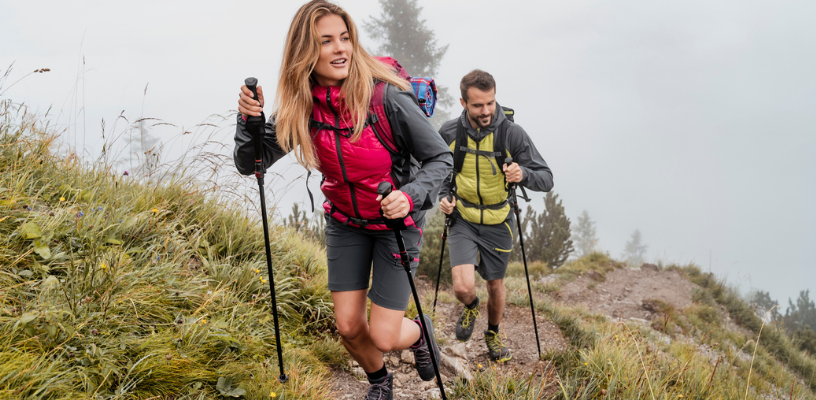
Trekking poles are indispensable equipment for countless mountain expeditions, providing crucial stability and significantly reducing strain on your knees, hips, and spine, particularly when you’re carrying a heavy backpack. Wondering which trekking poles are right for you, how to adjust them to your height, and what essential features to look for before making a purchase? This comprehensive guide will illuminate your path.
For some, hiking poles might seem like unnecessary bulk or merely a fashion statement; others view them as an optional accessory. Yet, a dedicated group of hikers wouldn’t dream of tackling mountain trails without poles strapped to their pack. While the decision to use trekking poles is largely personal, if you’re still on the fence, consider the compelling advantages they offer. When properly selected and adjusted to your height and specific needs, trekking poles provide a multitude of benefits, including:
- Joint Stress Reduction: They effectively alleviate pressure on the joints of your spine, ankles, and knees, especially crucial during demanding treks with a heavy pack.
- Improved Circulation & Reduced Swelling: The rhythmic motion of your arms while using poles promotes better blood flow, helping to minimize the risk of swelling in your hands, fingers, and wrists.
- Terrain Assessment & Hazard Detection: Poles can be invaluable for evaluating ground conditions and potential dangers. Use them to gauge water, mud, or snow depth when crossing streams or slopes, or to test ice stability.
- Versatile Utility: Beyond walking, poles can serve multiple purposes: assisting in setting up tents or lightweight shelters, acting as a monopod or tripod for cameras, or even clearing obstacles like overgrown bushes and cobwebs from your path.
It’s important to distinguish between trekking poles and Nordic walking poles, as they differ significantly in their intended use, construction, and technique. Trekking poles, designed for mountain terrain, are primarily built to reduce joint strain during ascents and descents with a backpack, enhance stability and balance on challenging ground, and improve overall performance, comfort, and safety on rugged trails. They typically feature a more robust construction and may be slightly heavier than Nordic walking models, often stowed on a backpack during easier, flatter sections of a trail.
Nordic walking poles, conversely, are engineered for exercise on relatively flat or gently undulating paths like parks, forest trails, or paved roads. They are lightweight, characterized by a specific half-glove strap system, and require a distinct walking technique. While trekking poles are generally positioned in front of the hiker, the correct Nordic walking technique involves planting the pole tip halfway between your feet, straightening the elbow, and releasing the hand as you push off.
Trekking poles come in either a fixed or adjustable design, allowing you to modify their length to suit varying terrain and conditions. Adjustable poles commonly feature telescopic or folding mechanisms, enabling them to collapse into a compact size for easy storage in or on your backpack. Adjustable poles are generally categorized by their segment count:
- 3-Segment Poles: This is the most prevalent configuration for trekking poles. Their ability to fold down to a highly compact size makes them an excellent choice for hikers prioritizing lightweight gear and easy packability.
- 4-Segment Poles: While potentially less stable and durable due to a higher number of moving parts, these models offer superior compactness. They are an outstanding option for those with limited pack space or who require extreme portability for long, challenging hikes.
The optimal length for a trekking pole allows your elbow to form approximately a 90-degree angle when you stand straight, hold the handle, and the tip rests on the ground near your foot. For maximum versatility, opt for an adjustable model, as you’ll quickly discover the benefit of altering the length (e.g., shortening by 5-10 cm for climbs and extending for descents). Correctly adjusting your poles is vital to prevent strain on your shoulders, neck, and back.
For 3-segment poles, it’s generally best to set the upper adjustment mechanism to the middle of its range, then fine-tune the lower adjustment to achieve that ideal 90-degree elbow bend. When you need to quickly change length on the go, primarily use the upper adjustment. Remember, the steeper the incline, the shorter your poles should be, providing better leverage and a more secure push-off. For traversing sloped sections, setting different lengths – shorter on the uphill side and longer on the downhill side – enhances stability.
Some poles feature an extended grip, often made of foam, below the main handle, known as a “lower grip.” This allows you to quickly choke up on the pole during short, steep ascents without needing to adjust the length. Fixed-length hiking poles are also available in various sizes; in this case, consult the manufacturer’s sizing chart to match the pole length to your height. For instance, a 110 cm pole from certain brands might suit individuals between 1.54-1.71 m, while a 120 cm pole would be recommended for those up to 1.82 m.
Trekking poles for mountain trails are typically crafted from carbon fiber, aluminum, or a blend of both. Carbon fiber is celebrated for its ultra-lightweight properties, excellent shock absorption, and high rigidity. However, it is more brittle than aluminum and can snap under extreme stress. Carbon fiber poles are often preferred by ounce-counting backpackers or those who only use poles for intermittent support. Aluminum construction, on the other hand, is highly durable, relatively lightweight, and reliable. While it might bend under significant impact, it often allows you to regain balance and continue your hike. Aluminum poles are a fantastic, more affordable choice for rugged terrain where consistent pole use is expected.
All types of trekking poles incorporate a locking mechanism to secure their segments and prevent movement during use. For fixed-length poles, these mechanisms merely lock the pole into its full extended position for use and unlock it for storage. Adjustable trekking poles utilize locking mechanisms that also facilitate the adjustment of their two or three interconnected segments, allowing precise length customization based on your height, the terrain, and trail conditions. There are four primary types of locking systems commonly found on hiking poles:
External (Flick-Lock)
This popular mechanism employs a lever, similar to a quick-release clamp, enabling swift and effortless length adjustments, even when you’re wearing gloves. External locking systems are highly regarded for their robust reliability and resilience in adverse weather conditions.
Internal (Twist-Lock)
To secure poles with this system, you simply twist two adjacent segments in opposite directions to engage the lock at your desired setting. It’s often a preferred choice in warmer, drier conditions. A potential drawback is that its performance can degrade over time if frequently exposed to mud or harsh weather, as internal grit can interfere with the mechanism.
Hybrid
A hybrid locking system offers a balanced approach to durability, weight, and user-friendliness. For example, a pole might feature an external lever lock on its upper shaft for quick adjustments and an internal twist-lock mechanism on its lower section.
Z-Pole (Probe-Style)
This advanced locking system provides an exceptional balance of low weight and ease of deployment. Z-style poles are constructed with a tension cord and a series of interlocking segments that fold quickly and compactly, much like an avalanche probe. This design makes them ideal for situations where minimal weight and effortless portability are paramount.
Now that you’re familiar with choosing hiking poles based on length, segment count, and material, what other critical features should you consider when selecting this essential expedition gear?
HANDLE
While shape plays a role, the most crucial factor in selecting a trekking pole handle is its material. Common options include foam, rubber, plastic, and cork. Cork handles are an excellent choice, offering a comfortable grip that conforms to your hand over time and effectively wicks away moisture, a significant advantage in warmer climates. Foam handles also provide comfort and moisture absorption. Rubber and plastic handles can be heavier, less absorbent, and may become slippery when wet, potentially causing discomfort or posing a safety risk. Look for poles with handles angled slightly forward (12-15 degrees) to promote a more natural and comfortable wrist position, reducing fatigue.
The integrated wrist strap (loop) is equally important. Choose a soft, adjustable model that allows you to customize its length for comfort and proper technique. Ideally, the strap should also be detachable for cleaning, repairs, or safety in situations where getting snagged (e.g., crossing very rocky terrain) could be dangerous.
TIPS
Most quality trekking poles are fitted with durable carbide tips, known for their extreme hardness and resistance to wear and damage. Less expensive models might use steel tips. The best solution is to opt for poles with replaceable tips, eliminating the need to buy a new pair when the original tips wear out.
BASKETS
Trekking poles often come with interchangeable baskets, typically in summer and winter (snow) versions. Summer baskets are smaller and prevent the pole from sinking too deep into soft earth. Winter baskets are larger in diameter, designed to provide more flotation and prevent the pole from plunging deep into snow.
Trekking poles might initially appear to be a non-essential piece of equipment, but their multifaceted utility does far more than just keep you stable. They significantly reduce stress on your joints and spine, make excursions considerably more comfortable, and aid in numerous trail activities. For many mountain hikers, they are a superb tool for moving faster and more efficiently, especially when carrying 15 kilograms (33 pounds) or more. If you’re ready to invest in these vital aids, consider reputable manufacturers such as Black Diamond, Leki, Gabel, Fizan, Viking, La Sportiva, Komperdell, Campus, or Masters. You’ll find high-quality hiking poles and pole accessories at Sport.ro. Ensure you select a model with the correct length to facilitate proper walking technique and fully reap the benefits they offer for your mountain adventures.